
Top Cities at Serious Risk of Flooding in Missouri

Missouri has some beautiful rivers and streams. The rolling hills in many places add a great deal to the state’s appeal. However, those rivers can flood, and those rolling hills can trap water and cause flash floods.
In 2019, flooding in northwest Missouri hit 1,812 properties, and the flood near Eureka in 2015 damaged 1,494 properties. Flooding is an ever-present danger in our state.
Missouri Cities at Risk of Flooding
The First National Flood Risk Assessment (FNFRA) in 2020 estimated that 280,200 properties are at risk of flooding in the state. They’ve further extended the review to cities and counties. Here are the top 10 cities.
| City | Properties at risk | Percentage of total properties |
|---|---|---|
| Kansas City | 14,927 | 8% |
| St. Louis | 13,149 | 10% |
| Springfield | 3,623 | 6% |
| St. Joseph | 3,549 | 11% |
| O’Fallon | 3,451 | 11% |
| Independence | 3,389 | 7% |
| St. Charles | 3,150 | 12% |
| Jefferson City | 2,369 | 14% |
| Columbia | 2,338 | 6% |
| Lee’s Summit | 2,280 | 6% |
Flooding Risk in Our Hometowns
We’ve gone further into the numbers for the locations in Missouri where we have offices.
Kansas City ranks at the top of the list. We’ve extended the review in the table below to include all counties touched by the city.
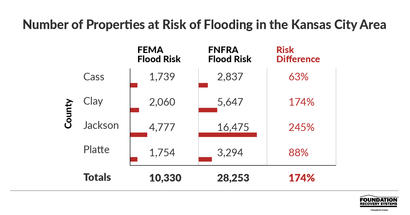
This broader review finds 28,253 properties at risk of flooding. Note the wide differences between the FEMA flood risk assessment and the First National Flood Risk Assessment. The latter takes into account areas that FEMA hasn’t yet mapped. Plus, it adds precipitation as a separate risk and also includes current climate data.
Moberly is in Randolph County, which shows 302 properties at risk in the FEMA report but a significant 187% increase to 867 properties in the FNFRA assessment.
Springfield, in Greene County, ranked third in the listing above with 1,775 properties in the FEMA report and 5,415 in the FNFRA report. That’s a staggering 205% difference.
St. Louis County shows 7,908 properties at risk of flooding in the FEMA assessment against 22,453 in the FNFRA report, a difference of 184%. The independent city of St. Louis, numbers not included in the county, shows 691 properties on the FEMA list and 9,076 on the FNFRA report. That’s a whopping difference of 1,214%.
All this demonstrates that just because your property isn’t listed in the FEMA flood risk assessment doesn’t mean that it isn’t subject to flood risk.
Flood Insurance
Home and property owners in Missouri have made 106,400 flood damage claims since 2000. These claims are through the National Flood Insurance Program and the Individual Assistance Program.
Note that these claims are made against flood insurance coverage. Most homeowner’s insurance doesn’t cover flood damage. It typically only covers damage caused by flooding from internal sources such as a burst water pipe. It does not cover flooding damage caused by external sources such as rain or storms.
To access the National Flood Insurance Program, use the FEMA Flood Map Service Center to map your property to determine flooding risks. From there, you can purchase flood insurance. It’s also wise to consult your insurance agent about all your coverage options.
Protect Your Property from Flooding
FEMA estimates one inch of water in an average 2,500-square-foot home can cause $23,635 in damage to the home and $3,172 to personal property. That should certainly be enough motivation to do all you can to protect your home from flooding.
Here are a few of the ways you can protect your home, basement, or crawl space from water damage caused by flooding.
- Gutters and Downspouts. Make sure your gutters and downspouts have adequate capacity for the expected rainfall. Install downspout extensions to move the water well away from the foundation. The surrounding landscaping should also be graded to ensure the water flows away from your home.
- Basement or Crawl Space Interior Drainage. Install a waterproofing system that includes interior drainage and a sump pump with battery backup to intercept leaking water and move it out before it builds up.
- Smart Water Sensors. Install smart sensors in your basement or crawl space as well as the lower levels of your home. They will notify you via a smartphone app that flooding is starting so you can take immediate action.
- Backflow Valves. Install backflow valves on sewer or septic system lines to prevent sewage from backing up into your basement or crawl space. This can happen during flooding when the sewage has nowhere else to go.
- Flood Vents. Install flood vents to help equalize the floodwater pressure on the foundation walls. They let water in to prevent the greater problem of basement or crawl space walls collapsing.
- Utilities. Flood water starts building up from the floor and soon overwhelms the electrical outlets, extension cords, as well as equipment on the floor. You can move the equipment and extension cords, but the outlets will need to be rewired and placed higher on the wall. At a minimum, shut off the electrical power as floodwaters rise.
- Your Possessions. If you have a basement office or file cabinets, move your valuable papers and possessions to a higher floor when flooding is expected.
Please take caution. If you’re in immediate danger from rising waters, protect your family. Move to higher ground or a second floor. Evacuation of the area is the absolute best approach.
Preparation
Starting with the list above is a good first step in preparing your home for potential flooding. We also recommend that you consult the professionals at Foundation Recovery Systems for a free inspection and repair estimate to identify any issues with your basement or crawl space that need attention in preparation for heavy rains and flooding.
FAQs
Attempting DIY repairs or solely replacing wet insulation are only temporary solutions. Entering your crawl space can be risky. Professional evaluation and remedies are advised for a durable resolution. Foundation Recovery Systems conducts thorough inspections of your crawl space, offering repairs customized to your needs.
A dehumidifier can help reduce humidity and minor condensation on the walls but will not resolve underlying issues causing the wetness, such as leaks or poor drainage.
Yes, prolonged exposure to moisture can weaken the structural components of the house, including foundation walls and support beams, potentially leading to serious damage.

Leah Leitow
Publish Date:
Last Modified Date:
Our Locations
3349 Southgate Ct SW,
Cedar Rapids, IA 52404
(319) 220-5034
14678 E 925 North Rd, Building 5
Bloomington, IL 61705
6300 NW Beaver Dr.
Johnston, IA 50131
(515) 373-8491
7280 NW 87th Terrace, Suite C-210
Kansas City, MO 64153
(816) 774-1539
211 SE State Route 150
Lee's Summit, MO 64082
(816) 774-1539
1872 State Hwy M
Moberly, MO 65270
(660) 202-8662
3020 N. Martin Ave.
Springfield, MO 65803
(417) 612-8286
1625 Larkin Williams rd.
Fenton, MO 63026
(314) 207-9995