
Understanding Soil Layers
In a previous article, we explored the question, “Is Damp Clay Soil Under My House a Cause for Concern?“
Now, we’re going to take a step back and discuss soil types in general. Let’s dive right in.
What is a Soil Layer?
From geography class, you already know that the earth is made up of different layers of sedimentation; it’s not just one big mass of rock or soil.
These layers were formed over hundreds and thousands of years due to wind, water, ice, the decomposition of plants and animals, and, more recently, human activity. They contain diverse materials, both organic and inorganic.
Here are the main soil layers:
- O Horizon (Organic Layer): The topmost layer, rich in organic material like decomposed leaves, plants, and insects. This layer is crucial for providing nutrients to plants.
- A Horizon (Topsoil): A mix of organic matter and minerals. It is darker and richer in nutrients, supporting most plant roots and biological activity.
- B Horizon (Subsoil): Contains minerals leached from the upper layers and is often denser and less fertile. This layer plays a key role in water retention and drainage.
- C Horizon (Parent Material): Made up of partially weathered rock and mineral particles. It serves as the foundation for the development of the upper soil layers.
- R Horizon (Bedrock): The bottommost layer, consisting of unweathered rock. It forms the base upon which all other soil layers develop over time.
Common Soil Types
Soils are classified by texture, engineering properties, and their suitability for foundation support. Their strength and stability depend on these physical properties. Common soil types include:
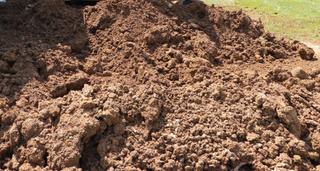
Man-Moved Soil
Soil that has been relocated from one site to another for construction is known as man-moved soil. Although it reduces waste, it may lack the necessary load-bearing capacity. To build on man-moved soil, it must be properly compacted. Poorly compacted soil can compress under a building’s weight, causing settlement and structural damage.
Backfill Soil
After foundation work, the excavated area around a structure is filled with backfill soil, which supports the foundation and promotes drainage. Common backfill types include:
- Coarse-grained Soils: Made up of gravel, sand, or a mixture, providing good drainage.
- Fine-grained Soils: Finer than coarse soils, with poor drainage but firm when compacted.
- Crushed Rock: Used for its compact base and excellent drainage properties.
Native Soil Layers
Naturally dense soils found at the construction site include:
- Clay: Expands when wet and contracts when dry, potentially causing foundation cracks. To stabilize, clay soil foundations must be dug deeper.
- Sand and Gravel: Large particles allow quick drainage, making them less likely to cause shifting. Compacting adds stability, making it ideal for building foundations.
- Bedrock: Deep and stable with a high bearing capacity, resistant to shifting and water damage. Structures built on bedrock are less likely to settle.
- Loam Soil: A mix of sand, clay, and silt, offering balanced support with minimal shifting or expansion and excellent water handling.
Understanding Soil Layers and Their Impact on Your Home
In this post, we covered the different soil layers and types, discussing their characteristics and how they affect your home’s foundation. Each soil type, from clay to bedrock, has unique properties that can impact stability, drainage, and overall support. Understanding these differences is crucial when planning for construction or repairs.
There’s much more to learn about soil and its role in construction, so in our next article, we’ll explore the question, “What is backfill in construction?“
If you need basement or crawl space foundation support, Foundation Recovery Systems offers a quick, easy, and completely FREE inspection—just click the button below to get started!
FAQs
Topsoil (A Horizon) is rich in organic material and nutrients, making it fertile, while subsoil (B Horizon) is denser, contains fewer nutrients, and holds more minerals.
Soil layers form due to the long-term processes of weathering, organic matter decomposition, and leaching, which creates distinct horizons over time.
Different soil layers have varying load-bearing capacities and drainage properties, which can impact the stability and durability of foundations and other construction projects.
Related Resources

Award-Winning Service










- 5/
- 5/
- 5/
- 5/
- 5/

Very professional and nice! Having an issue with a crack in the basement wall. Fast service, and pleasant to deal with.
Very professional and nice! Having an issue with a crack in the basement wall. Fast service, and pleasant to deal with.
- 5/
- 5/
- 5/
- 5/
- 5/
Dakota was fantastic. Super knowledgeable, asked great questions, gave guidance, and helped out a lot. While we didn’t need the services…
Dakota was fantastic. Super knowledgeable, asked great questions, gave guidance, and helped out a lot. While we didn’t need the services immediately, we were provided with a reasonable quote and will certainly reach out to FRS when we are ready! TY Dakota Reeder.
- 5/
- 5/
- 5/
- 5/
- 5/
FRS did the contracted work in a timely professional manner. Tanner, the foreman, was very professional and kept me well informed as the…
FRS did the contracted work in a timely professional manner. Tanner, the foreman, was very professional and kept me well informed as the work progressed.
- 5/
- 5/
- 5/
- 5/
- 5/
Zach was great! He called the day before to confirm my appointment. He called the day of to let me know he was on his way! I appreciate the …
Zach was great! He called the day before to confirm my appointment. He called the day of to let me know he was on his way! I appreciate the communication. He explained everything to me. He let me know that he cleaned my humidifier filter and that my pumps were working great! Thank you Zach for doing a great job!
- 5/
- 5/
- 5/
- 5/
- 5/
Wayne, Jordan and Alex all worked very hard and did a great job! Our home is restored.
Wayne, Jordan and Alex all worked very hard and did a great job! Our home is restored.
- 5/
- 5/
- 5/
- 5/
- 5/
Camden Daniel was very friendly, professional, and knowledgeable. He thoroughly looked over the entire basement and exterior where we…
Camden Daniel was very friendly, professional, and knowledgeable. He thoroughly looked over the entire basement and exterior where we thought we had a problem. He was very good to explain to us what we had going on and let us know that we didn't have anything to worry about. We really appreciated the honesty. Even though we did not have to schedule a repair, we will definitely call this company again if we need to and will recommend them to others. Thank you Camden Daniel for such a great experience!
- 5/
- 5/
- 5/
- 5/
- 5/
Brian German came out to inspect our foundation, crawl space, and sump pump and he did a fabulous job explaining all his findings to us. He …
Brian German came out to inspect our foundation, crawl space, and sump pump and he did a fabulous job explaining all his findings to us. He took great pics of the issues and recommended necessary next steps. Highly recommend!
- 5/
- 5/
- 5/
- 5/
- 5/
Jacob and Nolan were the nicest guys to work with. As a senior, I normally am very nervous when someone is working inside or outside of…
Jacob and Nolan were the nicest guys to work with. As a senior, I normally am very nervous when someone is working inside or outside of our home. My husband is under Hospice care and I am his only caregiver. I didn't even look out of the window while they were working. Why? Because, Jacob shook my hand, looked me in the eye and explained everything they were going to do. Very professional young men!! Thank you so very, very much!
- 5/
- 5/
- 5/
- 5/
- 5/
We are very pleased with the service we received! These young men were very punctual, thorough, knowledgeable and professional. They were…
We are very pleased with the service we received! These young men were very punctual, thorough, knowledgeable and professional. They were even polite when I asked the same questions repeatedly. lol Big shout out to CJ Schlater, Aundra Butner and Duncan Zimmer! Our house is no longer sinking away.
- 5/
- 5/
- 5/
- 5/
- 5/
I honestly couldn’t recommend Timber Shelton more! He is extremely knowledgeable and ensures that you’re comfortable through every step of…
I honestly couldn’t recommend Timber Shelton more! He is extremely knowledgeable and ensures that you’re comfortable through every step of the process. Thanks again for a job well done!
- 5/
- 5/
- 5/
- 5/
- 5/
Very professional and courteous. They explained each step and kept us informed on the progress. They finished the job on time.
Very professional and courteous. They explained each step and kept us informed on the progress. They finished the job on time.
- 5/
- 5/
- 5/
- 5/
- 5/
Tyler Marland and Martin did a good job
Tyler Marland and Martin did a good job
- 5/
- 5/
- 5/
- 5/
- 5/
Travis is very professional. Showed up to check our foundation. Very knowledgeable and explained everything clearly.
Travis is very professional. Showed up to check our foundation. Very knowledgeable and explained everything clearly.
- 5/
- 5/
- 5/
- 5/
- 5/
Excellent service. Very informative. Ed Macdonald from Foundation Recovery Systems was the best.
Excellent service. Very informative. Ed Macdonald from Foundation Recovery Systems was the best.
- 5/
- 5/
- 5/
- 5/
- 5/
Gary,Luca, and James were my crew for my project and they killed it! They completed the project, cleaned up and now I have a dry basement…
Gary,Luca, and James were my crew for my project and they killed it! They completed the project, cleaned up and now I have a dry basement and no more worries when it rains. Hire Foundation Recovery Systems , especially this crew.They did a great job. Thanks guys!
- 5/
- 5/
- 5/
- 5/
- 5/
So on Thursday my wife and I had an extremely positive experience with a man by the name Craig Chiles with Foundation Recovery Systems who…
So on Thursday my wife and I had an extremely positive experience with a man by the name Craig Chiles with Foundation Recovery Systems who came over to quote us a price on our driveway. Mr. Chiles was professional extremely well polished and courteous. He gave us a start to finish run down of the job we wanted done. We had a plan to get multiple quotes from other companies but I’m satisfied that we had a fair and honest assessment of our situation and we decided to go with this company. We would recommend Craig Chiles to anyone looking to get your foundation looked at and possibly repaired. Thank you sir it was a pleasure doing business with you. -Bert&Kelly
- 5/
- 5/
- 5/
- 5/
- 5/
Zach sanders, great job, great guy, explained everything easy to understand. A+ job…
Zach sanders, great job, great guy, explained everything easy to understand. A+ job…
- 5/
- 5/
- 5/
- 5/
- 5/
Nick Mata was very knowledgeable and informative about the issues at hand. He was also very helpful on getting the ball rolling.
Nick Mata was very knowledgeable and informative about the issues at hand. He was also very helpful on getting the ball rolling.
- 5/
- 5/
- 5/
- 5/
- 5/
The workers did excellent job installing our new sump pump and all the pipes. Thanks.
The workers did excellent job installing our new sump pump and all the pipes. Thanks.
- 5/
- 5/
- 5/
- 5/
- 5/
I engaged Foundation Recovery Systems to raise the sinking level of the main floor of my house when a trusted friend told me he'd had them…
I engaged Foundation Recovery Systems to raise the sinking level of the main floor of my house when a trusted friend told me he'd had them do work for him and was very happy. I am also. The company asked that 90 minutes of my time be set aside for the exploration of the site. The representative who came was excellent in explaining the company philosophy and connections, and then went into the crawlspace to check the situation. He came up and outlined what had to be done, the duties of the three-person crew itself, the materials to be used, and drew a schematic of the placement of the jacks. He wrote the estimate, I approved and made a down payment, and a day later, he phoned to tell me the two consecutive days he estimated the job would take. The crew arrived on the dot, and were very respectful of my home as they went about their business. The steel jacks they used looked like they could do the job and last forever. The company warranty extends to the next purchaser. It is expensive; I did not bother to get another estimate, I was sold on their contract and the fact my friend (a lifetime of working in construction) vouched for them.

Leah Leitow
Publish Date:
Last Modified Date:
Our Locations
3349 Southgate Ct SW,
Cedar Rapids, IA 52404
(319) 220-5034
14678 E 925 North Rd, Building 5
Bloomington, IL 61705
6300 NW Beaver Dr.
Johnston, IA 50131
(515) 373-8491
7280 NW 87th Terrace, Suite C-210
Kansas City, MO 64153
(816) 774-1539
211 SE State Route 150
Lee's Summit, MO 64082
(816) 774-1539
1872 State Hwy M
Moberly, MO 65270
(660) 202-8662
3020 N. Martin Ave.
Springfield, MO 65803
(417) 612-8286
1625 Larkin Williams rd.
Fenton, MO 63026
(314) 207-9995